If you are eyeing Desert Hot Springs as a lower-cost way into the Coachella Valley rental market, you are not alone. The price tags can look more approachable than nearby cities, but smart investing here still comes down to careful underwriting, local rules, and property-level due diligence. This guide walks you through what to weigh before you buy, from pricing and rent assumptions to vacation-rental limits and desert operating costs. Let’s dive in.
Why Desert Hot Springs Gets Investor Attention
Desert Hot Springs stands out as a lower-entry market compared with many nearby Coachella Valley cities. Realtor.com’s April 2026 snapshot shows a median sold price of $379,000 and a median list price of $419,500, which is well below places like Palm Springs, Palm Desert, La Quinta, and Cathedral City.
That lower entry point matters if you are trying to balance purchase price with rental income potential. Realtor.com also classifies Desert Hot Springs as a buyer’s market, with 795 homes for sale, 67 median days on market, and a 98% sale-to-list ratio. For investors, that can create room to compare options carefully instead of rushing into the first available deal.
Compare Desert Hot Springs to Nearby Markets
Desert Hot Springs does not compete on the same pricing tier as many neighboring desert cities. Realtor.com shows median listing prices of $594,750 in Palm Desert, $719,950 in Palm Springs, $557,900 in Indio, $899,000 in La Quinta, and $517,000 in Cathedral City. Riverside County overall also sits higher, at a $625,000 median listing price.
That spread is a big reason investors look here first. You may be able to buy into the valley at a lower basis, but you should also remember that local rents are generally lower than in some nearby resort-focused markets. A lower purchase price can help your numbers, but it does not guarantee a stronger return.
Start With Realistic Rent Assumptions
One of the easiest ways to misread a rental opportunity is to use outdated rent data or stretch for a best-case number. The Census Bureau’s QuickFacts profile lists a median gross rent of $1,412, while Realtor.com’s current market snapshot shows a median rent of $2,275. Those figures measure different things, but together they show why current market evidence matters.
If you are underwriting a long-term rental, it is safer to start with current rent comps and then work backward. Build in vacancy, leasing costs, repairs, property management, insurance, taxes, utilities, HOA dues if any, and local compliance costs. Gross rent can look attractive on paper, but net income is what determines whether a property truly works.
Know the Citywide Price Range
A citywide median can hide meaningful differences inside Desert Hot Springs. Realtor.com’s zip-code data shows a median listing price of $409,900 in 92240 versus $610,000 in 92241. That is a large gap for one city.
Neighborhood-level data also shows a fairly broad spread. Areas such as Mission Lakes Country Club, Wardman Heights, Dos Palmas, Desert Hot Springs Highlands, Desert Springs Estates, and Desert Hot Springs East generally fall in about the $385,000 to $450,000 listing-price band, with some lower-rent pockets around $2,198 to $2,300 per month. If you are ROI-focused, that is often where your analysis should start.
Most Inventory Is Single-Family
Desert Hot Springs is primarily a single-family market. The city’s 2023 housing parcel report shows 8,842 single-family residential parcels compared with just 187 multifamily parcels.
That matters because your deal options may lean heavily toward detached homes instead of small apartment buildings. Multifamily opportunities do exist, but they are much more limited. In practical terms, many investors here will be evaluating houses with outdoor space, not large income properties.
Budget for Desert Operating Costs
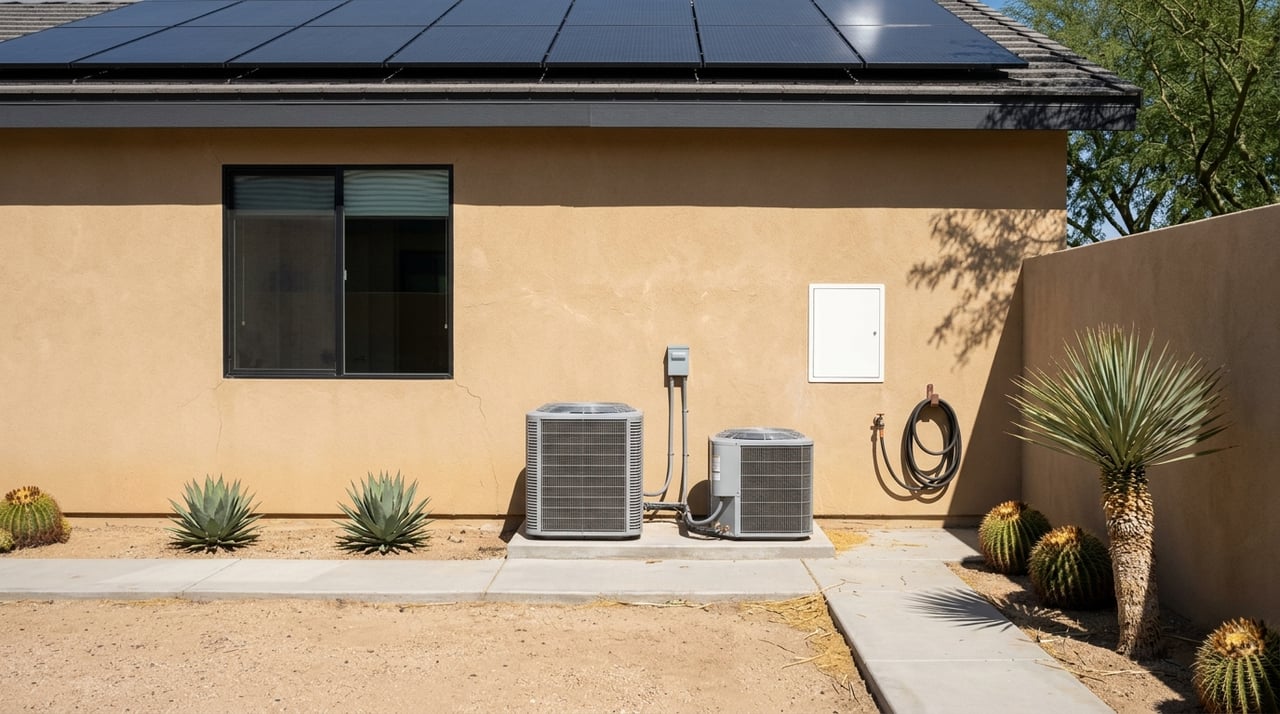
A property that looks affordable at closing can still become expensive to operate. In Desert Hot Springs, the local climate puts pressure on cooling systems, irrigation, roofs, pools and spas, and exterior materials. Mission Springs Water District reports average high temperatures above 100 degrees in June through September, with mean annual precipitation of only about 5.1 inches.
That climate profile should shape how you inspect and underwrite. HVAC age and capacity matter. So do landscaping choices, water demand, roof condition, and the maintenance needs of outdoor amenities.
Model Utilities Conservatively
Utilities are not a side note in this market. Mission Springs Water District says its rates effective February 17, 2026 include a $14.73 fixed monthly meter charge for a 3/4-inch single-family connection, tiered water use charges of $2.47 and $3.38 per CCF, a single-family sewer charge of $53.75 per month, a Desert Water Agency assessment of about $0.60 per CCF, and a 7% city Utility Users Tax on applicable water and sewer charges within city limits.
There is also an important billing detail to understand. Mission Springs Water District notes that residential sewer charges are billed annually on the property tax bill rather than on the monthly water bill. If you are estimating monthly carrying costs, make sure you do not miss that annual expense.
Property Taxes Need a Fresh Look
Do not rely on the seller’s current tax bill when you estimate ownership costs. The California State Board of Equalization explains that Proposition 13 generally limits the base property tax rate to 1% of taxable value, plus voter-approved bonds and other assessments.
Riverside County also issues supplemental tax bills after a change of ownership or new construction. That means your post-close tax picture may be higher than the seller’s current bill suggests. A conservative investor should reserve cash for that additional item rather than treat it as a surprise.
Long-Term Rental vs. Vacation Rental
Before you write an offer, decide which rental strategy you are actually pursuing. A long-term rental and a vacation rental can look similar at first glance, but they operate very differently in Desert Hot Springs.
A long-term rental is typically easier to model because you can focus on current rents, normal turnover, and standard operating costs. A vacation rental should be treated more like an operating business with licensing, inspections, tax collection, complaint response, and ongoing compliance duties.
Short-Term Rental Rules Are Strict
Desert Hot Springs regulates vacation rentals closely. The city requires a valid vacation rental permit to rent, advertise, list, book, or publish a unit for 30 consecutive days or less, and the owner must first obtain a business license.
The permit is valid for one year, must be renewed within the city’s stated renewal window, and does not transfer to a new owner. The city also recognizes different permit categories, including general vacation rental, home-share, and primary-residence vacation rental. If you are buying based on short-stay income, this is not a detail to review later. It is part of your upfront feasibility test.
New STR Supply Is Limited
Even if a property looks perfect for short-term use, it may not qualify for a new permit. The city caps new vacation rentals at 4% of completed developed housing parcels and requires at least 500 feet of separation from another vacation rental.
A property can also be denied if it sits in an HOA that prohibits the use. In addition, the city states that accessory dwelling units cannot be used as short-term vacation rentals. If your strategy depends on vacation-rental income, you need to confirm permit eligibility before your offer moves forward.
STR Compliance Is Operational, Not Passive
Owning a vacation rental in Desert Hot Springs means handling more than bookings. The city requires the permit to be posted and the current permit number to appear on online listings. The city also states that hosting platforms may not book a stay unless the permit is current and valid.
Enforcement expectations are serious. The city’s staff report says listings without a current permit number may be removed after notice, and owners or agents must respond physically to complaints within 30 minutes. The inspection process reviews issues such as noise, trash, parking, landscape conditions, fire hazards, and pool or spa safety.
Factor in STR Taxes
Short-term rental revenue is not your keep-all top line. The city states that vacation rental owners must pay a 12% transient occupancy tax and a 1% Greater Palm Springs Tourism Business Improvement District assessment on gross revenue for stays of 28 days or less.
That means your gross booking total can overstate your real operating performance if you fail to model these items from the start. For many buyers, this is the point where a promising vacation-rental concept starts to look more like a hands-on business than a passive investment.
Questions to Answer Before You Offer
A careful buyer should pressure-test the property before getting attached to projected returns. In Desert Hot Springs, a few questions can quickly separate a viable rental from a risky one.
- What is the realistic rent strategy? Decide whether the property is best suited for long-term leasing or if you are pursuing a vacation-rental model.
- Does the location support the numbers? Review the specific zip code, neighborhood pricing, and likely rent level instead of relying on a citywide average.
- What utilities serve the property? Desert Water Agency notes that many customers in Desert Hot Springs are served by Mission Springs Water District, while some are served by Coachella Valley Water District, and Mission Springs handles sewer connections.
- What will summer operations cost? Budget for higher cooling demand, irrigation, and upkeep during the hottest months.
- Is there an HOA restriction? If the property is in an HOA, confirm whether the planned rental use is allowed.
- If the plan is STR, can it actually qualify? A prior owner’s permit does not transfer, and city cap, spacing, HOA, and ADU rules all matter.
- Have you reserved for supplemental taxes? Post-close property tax adjustments in Riverside County should be part of your cash planning.
- Who will manage compliance? If the property will be a vacation rental, someone must handle inspections, complaint response, and permit-number requirements.
What a Smart Purchase Looks Like
A strong Desert Hot Springs rental purchase is usually not the cheapest house on the market. It is the property where the numbers still make sense after realistic rent assumptions, utility costs, property taxes, maintenance, and local rules are all on the page.
That is especially true in a desert market where operating costs can swing quickly based on condition and setup. A house with aging HVAC, high water use, deferred exterior maintenance, or an unworkable vacation-rental plan can erase the advantage of a lower purchase price.
Why Local Analysis Matters
Desert Hot Springs can be a compelling entry point for investors who want Coachella Valley exposure without buying at Palm Springs or La Quinta price levels. But this is not a market where broad averages tell the whole story.
You need neighborhood-level pricing, realistic rent expectations, and a clear understanding of whether you are buying a long-term income property or a tightly regulated short-term rental business. That kind of analysis can help you avoid overpaying, underestimating costs, or chasing a strategy the property cannot legally support.
If you want help evaluating a Desert Hot Springs rental through a more local, appraisal-minded lens, The Nick Miller Team can help you compare neighborhoods, pressure-test deal assumptions, and make a more confident investment decision.
FAQs
What makes Desert Hot Springs appealing to rental investors?
- Desert Hot Springs offers a lower entry price than many nearby Coachella Valley cities, while still showing active for-sale and rental inventory that investors can analyze.
What is the median home price in Desert Hot Springs?
- Realtor.com’s April 2026 snapshot shows a median sold price of $379,000 and a median list price of $419,500.
Is Desert Hot Springs a buyer’s market for investors?
- Realtor.com classifies Desert Hot Springs as a buyer’s market, with 795 homes for sale, a median of 67 days on market, and a 98% sale-to-list ratio.
Are most rental properties in Desert Hot Springs single-family homes?
- Yes. The city’s 2023 housing parcel report shows 8,842 single-family residential parcels and 187 multifamily parcels, so most investor opportunities are likely to be detached homes.
Can you buy a Desert Hot Springs home for short-term rental use?
- Possibly, but the city requires a valid vacation rental permit, applies a 4% cap on new vacation rentals, requires 500 feet of spacing from another vacation rental, and may deny use if an HOA prohibits it.
Does a seller’s short-term rental permit transfer to a new buyer in Desert Hot Springs?
- No. The city states that a vacation rental permit is not transferable to a new owner.
What taxes should investors budget for in Desert Hot Springs?
- Investors should conservatively model property taxes, possible supplemental property tax bills after closing, and for short-term rentals, a 12% transient occupancy tax plus a 1% Greater Palm Springs Tourism Business Improvement District assessment on stays of 28 days or less.
Why are utility costs important for Desert Hot Springs rentals?
- The desert climate increases cooling and water demand, and local charges can include fixed water fees, tiered usage rates, sewer charges, a Desert Water Agency assessment, and a 7% city Utility Users Tax on applicable charges within city limits.