For years, buyers shopping at Palm Desert Resort Country Club learned to watch three numbers: the purchase price, the monthly HOA dues, and whatever rate their lender quoted that week. Put enough down, qualify on income, and the loan followed. As of this summer, a fourth number decides whether that loan exists at all, and it's not one any buyer controls. It's the deductible written into the HOA's master insurance policy, and if it's too high, every unit in the complex, not just the one under contract, can lose access to conventional financing.
That's the mechanism behind Fannie Mae and Freddie Mac's Lender Letter LL-2026-03, issued jointly on March 18, 2026, with two deadlines that have already landed. A $50,000 cap on per-unit insurance deductibles applies to loan applications dated on or after July 1. The streamlined "Limited Review" approval path for condo buildings with 11 or more units retired on August 3. Palm Desert Resort Country Club, known locally as The Resorter, has roughly 960 units built between 1981 and 1989 across multiple tracts. That size puts it squarely in the range where every conventional loan now requires the deeper scrutiny of a Full Review, regardless of how much a buyer puts down.
What Full Review actually asks for
Before August 3, a buyer putting 10 percent or more down on a primary residence in a large condo building could often skip past a detailed audit of the HOA's finances through Limited Review. That shortcut accounted for roughly 40 percent of all condo project reviews nationally, according to figures cited by the Community Associations Institute. It's gone now for buildings this size. Every loan application triggers Full Review instead, which means the underwriter isn't only checking the buyer's credit and income. They're auditing the association itself: current reserve study, insurance declarations, a delinquency aging report, board minutes, and disclosure of any pending litigation.
| Before August 3, 2026 | After August 3, 2026 | |
|---|---|---|
| Buildings with 11+ units | Limited Review often available at 10%+ down (primary) or 25%+ (second home/investment) | Full Review required on every loan, any down payment |
| Master policy deductible | Reviewed case by case, often quoted as a percentage of coverage | Flat $50,000 per-unit cap; anything higher fails the whole project |
| Reserve funding minimum | 10% of annual assessment income | Rising to 15%, for loan applications dated January 4, 2027 and later |
The deductible math that decides the whole building
Here's why the deductible cap matters more than it sounds. Many condo master policies still express their deductible as a percentage of the building's insured value rather than a flat dollar figure. That percentage looked reasonable on paper for years. Converted to dollars in this insurance market, it often isn't.
Take a building insured for $24 million with a 5 percent deductible, not an unusual structure for an older, amenity-heavy complex. That's a $1.2 million deductible. Under the new rule, anything above $50,000 fails the review, and it doesn't matter whether a loss ever happens. The number alone is enough to make the whole project non-warrantable, meaning no Fannie Mae or Freddie Mac backed loan can close in that building until the HOA restructures its coverage.
That's the part worth sitting with if you're reviewing a resale packet from a complex built in the 1980s where dues already bundle insurance, water, and roof maintenance into one monthly figure. The insurance summary buried in the estoppel packet used to be a due-diligence formality. Now it functions closer to a financing gatekeeper.
Why the timing lands hard on a complex like this
Palm Desert Resort Country Club isn't a hypothetical case. It's an established, multi-tract HOA old enough that its buildings predate almost every modern insurance underwriting standard, at a moment when California's insurance market is pushing carriers to raise deductibles specifically to hold premiums down. Industry analysts tracking 2026 HOA renewals describe carriers pulling out of parts of the state entirely, leaving the ones that remain leaning on higher deductibles as their main lever against rising claims costs. That's exactly the pressure that can push a master policy's deductible past $50,000 without anyone on the board treating it as a red flag, because for years it wasn't one.
A national survey of more than 700 HOA board members and managers by CAI's Foundation for Community Association Research found that 42 percent didn't know whether their own community qualified for federally backed financing. Among those already found ineligible, 64 percent said the denial had already hurt home sales or property values. That's not a Palm Desert-specific number, but it describes the exact blind spot this rule change exposes.
One Sacramento-based residential appraiser who publishes a closely followed California housing market blog noted late last year that condo cancellations were running higher than they'd been in a decade, a trend he tied largely to insurance-driven softness rather than buyer demand. Insurance cost pressure is showing up as financing friction before it shows up as falling prices, which is precisely the order of operations a buyer at PDRCC needs to understand before writing an offer.
Not every change in LL-2026-03 tightens things, either. The rule also eliminated the old 50 percent investor-ownership concentration cap for established buildings under Full Review. That's relevant here because Palm Desert Resort Country Club is one of the communities in the area that permits short-term rentals, which means a meaningful share of its units are investor owned rather than owner occupied. That cap used to work against complexes with this ownership mix. It doesn't anymore.
What to actually request, and when
Our own buyer's guide to Palm Desert Resort Country Club already lists the documents that belong in a resale packet here: CC&Rs, bylaws, current budget, latest reserve study, insurance summary, disclosure of pending special assessments, current assessments, twelve months of board minutes, and any litigation disclosures. Under the old rules, most buyers treated that packet as something to skim after their offer was accepted. Under Full Review, it's the document set your lender needs in full before they can even confirm the building qualifies.
Ask for these on day one of escrow, not week three:
- The current insurance declarations page, with the per-unit deductible spelled out in dollars, not just a percentage
- The most recent reserve study, compared against what the association is actually funding
- A current delinquency or aging report. Fannie Mae caps delinquency at 15 percent of owners more than 60 days past due before the whole project loses warrantable status
- Written confirmation of any active litigation, since construction-defect or structural claims can block financing independent of the insurance numbers
- Whether your specific building carries a sub-association fee on top of master HOA dues, since PDRCC's multiple tracts don't all carry identical coverage
Getting these documents early doesn't just protect your closing date. It tells you, before you write an offer, whether the building you're buying into can actually be financed the way you're planning to finance it.
The one California condo warning that probably doesn't apply here
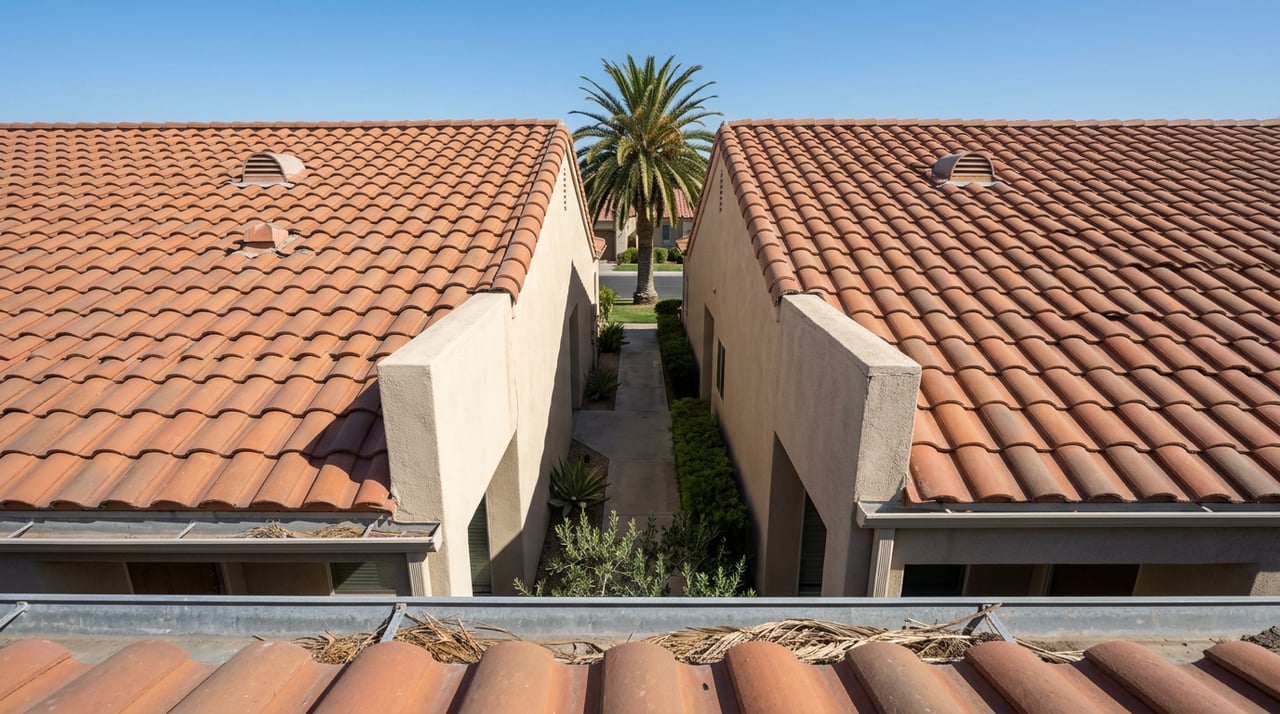
If you've read anything about California condo financing this year, you've likely seen warnings about SB 326, the state's elevated-walkway and balcony inspection law that has been showing up alongside nearly every discussion of California condo lending in 2026. It's a real issue for buildings with elevated exterior walkways and structural components exposed to the elements. Palm Desert Resort Country Club is built out of single-story, paired attached condos with ground-level patios rather than elevated corridors, so the inspection exposure driving that law doesn't obviously apply here the way it would to a taller building with elevated walkways. Confirm directly with the HOA if you want that in writing, but it's worth knowing which California condo warnings are actually about your building and which ones are generic noise attached to every condo article published this year.
If you're already under contract, or already own here
Existing owners with loans already closed aren't affected retroactively. The exposure surfaces at the next sale or refinance in the building, which for a 960-unit complex with regular turnover isn't an abstract future problem. If you're currently in escrow, ask your lender directly whether your file already cleared under the old Limited Review standard or whether it's being processed as a Full Review under the new rule. If you're selling, get ahead of it. A listing agent who can hand a buyer's lender a clean insurance declarations page and current reserve study on day one is offering something that, as of this year, actually changes whether a deal closes.
FAQ
Does this rule apply to cash buyers? No. The Fannie Mae and Freddie Mac review process only governs conventional, agency-backed loans. Cash purchases and portfolio loans from lenders who hold their own paper aren't subject to the Limited Review elimination or the deductible cap, though a portfolio lender may still ask similar questions of its own.
Will this make Palm Desert Resort Country Club harder to sell? It depends entirely on what's currently in the HOA's insurance policy and reserve study, documents that are knowable today rather than something to discover mid-escrow. A board already carrying a deductible under $50,000 per unit and healthy reserve funding won't feel this rule at all.
What happens if the building fails Full Review? The unit doesn't disappear from the market. It moves into a smaller pool of buyers who can pay cash or qualify for a portfolio loan, which typically means larger down payments and higher rates. That narrows the buyer pool for sellers and narrows the financing menu for buyers.
If you're weighing a purchase or a sale at Palm Desert Resort Country Club this fall, the numbers that matter most now live inside the HOA's own paperwork, not the listing sheet. As a certified residential appraiser working this specific community, Nick Miller can pull the current insurance declarations and reserve study before you write an offer, or before you list, so a financing surprise doesn't show up in week three of escrow. Get Your Home Valuation and let's look at the numbers your lender is actually going to look at.